


Factory Idle

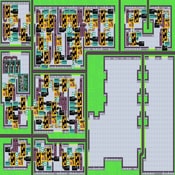
You watch the counter on your first Iron seller sit frozen while ore keeps piling up on the belt behind it, and it takes a second look to realize the problem isn’t the seller at all, it’s that your foundries can’t process ore fast enough to keep the line moving. That moment, staring at a backed-up conveyor instead of a rising bank balance, is where Factory Idle actually starts teaching you how it works, long after the tutorial text has stopped talking.
| Genre | Incremental Factory Automation |
| Platform | Browser (HTML5) |
| Core Loop | Buy resources, process them through machines, sell the output, reinvest in more factories and areas |
| Starting Resources | $2,000 cash, first factory available for $100 |
Building the First Iron Line in Factory Idle
Every run of Factory Idle begins the same way: no factory owned, a few thousand dollars in cash, and a first factory available for a hundred dollars with ten areas, nine purchasable. That first factory teaches the vocabulary the rest of the game runs on, since every later factory reuses the same basic pieces at a larger scale.
The community-tested layout for that opening iron line is four Iron ore buyers feeding two Iron foundries into a single Iron seller, which produces a fully effective setup rather than one where buyers sit idle or a foundry starves for input. Getting that ratio wrong in either direction is the first real lesson the game teaches: too many buyers and ore backs up with nowhere to go, too few and the foundry runs under capacity no matter how many sellers you add downstream.
Once Iron is flowing cleanly, Steel is the natural next step, since a Steel foundry consumes both Iron and Coal rather than raw ore directly. That single dependency change is what turns a simple buy-process-sell chain into something closer to a small supply network, and it’s the first point where laying out conveyors cleanly starts to matter as much as owning the right machines.
Ticks, Not Real Time, in Factory Idle
Machines in Factory Idle don’t process on a real-time clock, they process in ticks, and every machine’s stated cycle time is measured in ticks rather than seconds. An Iron foundry, for example, consumes two units of Iron ore every ten ticks to produce one unit of Iron, and a Steel foundry consumes four Iron and four Coal every ten ticks to produce one Steel. Nothing about those numbers changes as more real time passes; output speed depends on ticks per second, a research-driven stat rather than a fixed constant.
This is one of the more disorienting things for new players coming from other browser idle games, where more elapsed time always equals more progress. Here, a factory left running with too few ticks per second and a poorly tuned layout can sit at low output indefinitely, no matter how many hours pass, until you actually go in and fix the bottleneck or research more speed.
Conveyors and the Clockwise Logic of Sorters
Conveyors connect components by click-dragging from the source to the destination, and each conveyor has a hard limit of ten items it can move per tick. A single conveyor between a fast foundry and a slow seller will bottleneck the whole line even if both machines are individually healthy, which is why doubling up on conveyors out of a congested component is a standard fix rather than a workaround.
Sorters add a layer most beginners misjudge the first time they place one. Inputs and outputs follow a fixed clockwise order, top, then right, then bottom, then left, and a sorter only accepts conveyor inputs from the middle of its two long sides, capping it at two inputs regardless of layout. Sorters also need manual configuration to decide which output lane handles which resource, including a lane for waste, and skipping that step is a common reason a freshly placed sorter appears to do nothing.
From Steel to Plastics and Electronics
Past Steel, Factory Idle branches into resource types that don’t share ingredients with metal production at all. Plastics draw from Oil and Gas buyers rather than ore, and Electronics run through Silicon buyers, which means a player who has only ever built metal chains has to essentially learn a second parallel supply line from scratch rather than extending the one they already know.
This branching is deliberate rather than a design gap. Because Plastics and Electronics need entirely different upstream buyers, a factory floor that tries to host both a metals chain and an electronics chain side by side has to solve a real spatial puzzle, since floor space inside each factory area is limited and every additional buyer, maker, or seller competes for the same room that conveyors need to snake through.
Guns, Engines, and the Jump to Tanks
Later production lines pull metals and electronics back together rather than replacing them. Guns are built from an Explosives buyer and Bullet makers feeding into Gun makers and Gun sellers, while Engines draw on Aluminium buyers feeding Engine makers and Engine sellers. Tanks sit a tier above both, since a Tank hull maker, Tank turret maker, and Tank assembly component all require completed Guns and Engines as inputs before a Tank seller can turn the finished product into money.
That convergence point is where a lot of players first feel the game’s real difficulty, because a Tank line isn’t forgiving of a weak Gun chain or a weak Engine chain feeding into it. If either upstream chain is undersized, the Tank assembly line runs below its potential no matter how well-built it is on its own, which pushes players to think about the whole factory as one interconnected system rather than a set of separate profit centers.
- Explosives buyers and Bullet makers feed Gun makers, which route finished Guns to a Gun seller or onward to assembly.
- Aluminium buyers feed Engine makers, which route finished Engines to an Engine seller or onward to assembly.
- The Tank hull maker and Tank turret maker prepare components that the Tank assembly combines with completed Guns and Engines.
- A Tank seller converts the assembled output into cash, closing the chain that started back at the ore buyers.
Research Centers, Labs, and the Chronometer
Research centers generate research points every tick, and that generation rate can be boosted by feeding a research center from a research lab, which produces reports rather than a physical resource. Points earned this way unlock further components and upgrades, including the Chronometer, a research item that adds one additional tick per second for each level purchased, making it one of the few upgrades that speeds up literally every machine in every factory at once rather than just one production line.
Because labs need a mix of resources to run effectively, building one usually means diverting output that would otherwise be sold, which is a real trade-off rather than a bonus with no cost. Players chasing faster ticks through the Chronometer have to accept slower cash growth in the short term to get there.
The Cost Wall Between Your First and Second Factory
The jump in scale between factories is steep by design. Where the first factory costs $100 and offers ten areas, the second costs roughly a billion dollars for only six areas, five purchasable. That gap is wide enough that players commonly report earning comfortably in the millions while still nowhere close to affording the next factory, a complaint raised often enough on the game’s Kongregate forum that balancing update 1.06 was released to make new content unlock two to three times faster than before.
That kind of exponential cost curve is a deliberate pacing choice in Factory Idle rather than a bug, but it does mean the mid-game can feel like a plateau if you’re judging progress purely by how close you are to the next factory rather than by how efficient your current one has become.
Efficiency Percentages and Why Machines Stall
Every component reports an efficiency percentage, and it’s common for a new player to see a number well under 100 percent and assume something is broken. Often it isn’t. A machine with a small output stock relative to how much it processes per cycle, for example one that only holds six items but processes ten per ten ticks, simply cannot register full efficiency because it can’t accumulate enough backlog to run at its stated rate.
The other common cause is a backed-up out-conveyor, where a machine is producing fine but has nowhere to send its output fast enough, dragging its own efficiency down even though the fault sits downstream. Adding a second out-conveyor from a congested component is the standard fix players reach for once they recognize the pattern, and learning to read efficiency numbers this way, as a diagnostic tool rather than a simple health bar, is one of the clearer signs a player has moved past the early game.
What Players Actually Debate About Factory Idle
Discussion on the game’s Kongregate forum has never been shy about what’s missing. Two requests come up repeatedly: a color-coded overlay showing at a glance which components run at peak efficiency without clicking into each one, and a blueprint mode that would let a player design a new layout on paper while the current factory keeps earning, then swap it in all at once instead of tearing down a working line mid-build. Neither has changed the base game, but both point at the same friction, that optimizing a factory by hand across dozens of components is tedious in a way the interface doesn’t fully solve.
A separate complaint runs the other direction. At least one reviewer flagged that Factory Idle does not always idle the way its name promises, since closing the browser window can halt progress instead of letting it continue quietly in the background, undercutting the offline-earning premise players expect from the genre. That’s worth knowing before planning around long stretches away from the screen rather than short return visits.
What balances the complaints is the satisfaction players consistently describe once a layout finally clicks, watching resources move from buyer to foundry to seller in perfect sync with nothing stalling anywhere along the belt. That payoff is arguably the whole point of the genre, and Factory Idle delivers it more directly than most because the plumbing is visible rather than hidden behind an abstract progress bar.
Is there a prestige or reset system in Factory Idle?
No prestige mechanic has been documented for Factory Idle. Progress instead comes from buying additional factories and areas outright, with each new factory dramatically more expensive than the last, so the sense of a fresh start that other idle games deliver through prestige currencies comes here from unlocking a new factory layout to design rather than from resetting an old one.
Why is my machine stuck below 100 percent efficiency in Factory Idle?
Low efficiency usually traces back to either an output stock too small to sustain the machine’s processing rate or a backed-up out-conveyor that can’t clear items fast enough. Checking both, and adding a second out-conveyor where needed, resolves the majority of efficiency complaints reported by players.
How do sorters work in Factory Idle?
Sorters route resources in a fixed clockwise order across their four sides and only accept conveyor inputs from the middle of their two long sides, capping them at two inputs each. They also need to be manually configured to assign which output lane carries which resource, including a lane for waste, or the sorter will not distribute anything correctly.
What keeps players coming back to Factory Idle despite the punishing cost wall between factories is the same thing that made that first frozen Iron seller worth investigating in the first place: a correctly wired Steel foundry, or a Tank assembly line finally fed by two healthy upstream chains, turns a stalled floor into one that hums along on its own, and chasing that fix is a large part of why the grind between factory tiers still feels worth climbing.