


Family Secrets 1: Empty Plate

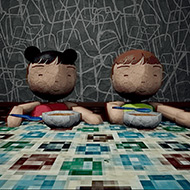
You step through the door on a dare, nothing more, telling yourself three days inside an abandoned building is an easy way to prove a point and maybe get some good footage out of it. The lights flicker once, the hallway stretches longer than it should, and by the time the door shuts behind you, Family Secrets 1: Empty Plate has already stopped pretending this is just an empty flat. There is no weapon in your hands and no map to check, only whatever you can piece together from what the previous residents left behind.
| Genre | First-person psychological horror |
| Platform | Browser |
| Core Loop | Explore the flat, avoid detection, gather clues, survive without combat or traditional saves |
What Happens When You Step Into Family Secrets 1: Empty Plate
The setup is simple on the surface: you agreed to stay inside a rundown apartment building for a set stretch of time, and the building has other ideas about how that stay is going to go. There is no onboarding tutorial walking you through systems, because there are barely any systems to explain. Movement, observation, and interaction with the environment are the entire toolkit.
What makes the opening stretch effective is how ordinary everything looks before anything happens. Empty rooms, dusty furniture, a building that has clearly been abandoned for a while, and nothing yet to suggest the scale of what is wrong with it. That slow unease before the first real disruption is doing more work than any jump scare could.
Once things do start shifting, Family Secrets 1: Empty Plate makes it clear there is no going back to treating the building as just a location. Doors that led somewhere a moment ago lead somewhere else now, and the layout itself becomes something you can no longer fully trust.
The Blackouts, the Marble, and the Security Room Routine
A recurring rhythm forms early and repeats through much of the experience: a faint marble-like sound signals something is active nearby, the power cuts out shortly after, and the fastest way to understand what just happened is to get to a security room and check the cameras. It is a tense little routine the first few times it happens.
By the time you have been through it several times, the pattern becomes recognizable enough that some of the tension shifts from not knowing what is coming to managing the same threat with practiced steps. That repetition is one of the more debated aspects of the game among players, since the loop is effective early on but starts to feel formulaic by the later stretches of a playthrough.
What Is Watching From the Dark Corners of the Flat
The building is not empty, and the presence sharing it with you is described by players as mannequin-like, unsettling specifically because of how still it holds itself until it registers that you are looking at it. That detail, being watched only once you look back, is the single most mentioned moment in player discussion of the game.
There is a minor inconsistency some players point out, where the creature reacts to being seen in ways that do not quite line up with earlier hints that it should not be able to see at all. It is a small logic gap rather than a major flaw, but it is the kind of detail attentive players notice on a second playthrough.
Beyond that presence, the game leans on unnamed intruders and general signs that you are not the only person moving through the building, which keeps the sense of being hunted from ever fully resting even during quieter stretches.
Journals, Candles, and Piecing Together Who Went Missing
Progress here depends on reading, not fighting. Journals and scattered belongings left behind by former residents are how the missing-persons thread gets filled in, piece by piece, without ever handing you a straightforward summary. Candles and lighters double as light sources and as small moments of relief in rooms that otherwise offer none.
- Journals and personal belongings left by former residents
- Candles and lighters used for light in darker rooms
- Surveillance cameras accessible from security rooms
- Environmental details like switches and drawers tied to puzzle solutions
None of this is optional flavor text. The building’s layout and behavior shift around certain story beats, so the clues gathered from journals often explain why a hallway that used to be safe suddenly is not, or why a room you already searched has changed since your last visit.
The Chase Sections and Why They Divide Players
Roughly midway through, calmer exploration gives way to direct chase sequences where hiding and quick decisions matter more than careful observation. Some players find these sections genuinely effective, praising how well-crafted the escape moments feel under pressure.
Others feel the shift undercuts the slower, more psychological horror the earlier sections had built up, arguing that active pursuit sequences trade atmosphere for a more conventional survival-horror rhythm. Both reactions show up regularly in player discussion, which suggests it comes down to what kind of horror a given player came in looking for.
Whichever side of that debate you land on, the game gives you no weapon to fight back with in these moments. Hiding, misdirection, and knowing the building’s quirks are the only real tools available once a chase begins.
No Map, No Traditional Save, and Why That Matters
There is no map overlay to lean on and no conventional save system to fall back on if a section goes badly. That absence is a deliberate pressure point: every route through the flat has to be learned by memory, and every mistake carries more weight without a safety net to undo it.
It is also why returning to Family Secrets 1: Empty Plate for a second attempt at a particular ending feels different from replaying a game with checkpoints. You are rebuilding your mental map of the building from scratch each time, which keeps even a familiar layout feeling slightly uncertain.
How many endings does Family Secrets 1: Empty Plate have?
The story branches into several distinct endings depending on choices and discoveries made in the final stretch, including at least one ending tied specifically to escaping the building rather than staying to see everything through.
Can you fight back against what is inside the building?
No. There is no combat system or weapon to collect. Survival depends entirely on hiding, avoiding detection, and using the environment, including security rooms and light sources, to stay ahead of whatever is hunting you.
Is there a way to save progress mid-playthrough?
Not in the traditional sense. The game does not offer a conventional save system, so a full attempt is generally meant to be carried through in one sitting rather than paused and resumed freely.
What lingers after finishing Family Secrets 1: Empty Plate is not any single scare but the slow accumulation of a building that never quite behaves the way it should, from the marble-sound blackouts to the mannequin-like figure that only reacts once it knows you are looking. It is a rough, occasionally repetitive experience, but the unease it builds around an ordinary abandoned flat is exactly what stays with people afterward.