


Librarian: Tidy Up The Arcane Library!

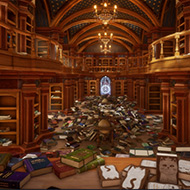
In Librarian: Tidy Up The Arcane Library! you start each case with almost nothing: a sketchbook, a pencil, and a magnifying glass. There is no inventory to manage and no combat to worry about, just a scene full of small details waiting to be examined and a hand that has to draw what it finds. That starting condition matters more than it sounds, because everything the game asks of you afterward builds directly on those three tools and nothing else.
| Genre | Point-and-click mystery and detective puzzle |
| Platform | Browser |
| Core Loop | Examine a scene, memorize details, sketch matching clues, piece together the case |
The Sketchbook, the Pencil, and the Magnifying Glass in Librarian: Tidy Up The Arcane Library!
The moment-to-moment gameplay here revolves around a small set of tools used over and over. The magnifying glass is what you reach for first, letting you zoom into a scene and search for anything out of place. Once something catches your eye, the pencil takes over, and you have to recreate the shape and position of whatever detail you just found rather than simply clicking on it.
That drawing step is what separates this from a standard hidden-object game. It is not enough to notice a clue; you have to reproduce it accurately enough for the game’s recognition system to accept it. Right-click rotates the pencil to match an object’s angle, which becomes essential once scenes stop offering clues sitting neatly upright.
- Magnifying glass for zooming into scene details
- Pencil tool for sketching and recreating clues
- Right-click to rotate the pencil to match an object’s angle
- A drawing recognition system that checks each sketch against the real object
New players tend to expect different default controls, since it is common to assume a right-click brings up a menu rather than rotating a tool, or that a dedicated key rather than a held gesture handles the magnifying glass. Working out this control scheme is one of the first small hurdles the game puts in front of you.
Investigating the Case at the Center of the Story
Underneath the puzzle mechanics is a short but genuinely unsettling investigation. The case that anchors the experience centers on a man named Richard Green, and the details you uncover about him, piece by piece, are what the sketching and searching are actually in service of. It plays less like a checklist of objects to find and more like slowly reconstructing what happened to one specific person.
There is a quiet tension running underneath the puzzle-solving, since the person doing the investigating is dealing with their own unresolved history at the same time as they work the case. That double layer, a mystery about someone else wrapped around a mystery about the investigator, is a big part of why the ending lands the way it does for most players.
Memory, Drawing Accuracy, and Where Players Get Stuck
A lot of the difficulty here is less about spotting clues and more about remembering them correctly once you move away from the scene that contained them. Several puzzles require you to recall a detail from an earlier moment and reproduce it later without being able to glance back at the original, which is where the memory element becomes as important as the drawing itself.
Drawing accuracy is the other common sticking point. The recognition system is generally forgiving about rough sketches, but some players run into moments where a correctly identified clue still will not register because the shape or angle drawn does not read as close enough. This is one of the more frequently mentioned frustrations in player feedback, alongside occasional lag that makes fast, precise sketching harder than it should be.
Because the whole loop leans on close attention rather than reflexes, players who rush through scenes tend to miss details that later puzzles assume you already noticed, forcing a return trip to an earlier screen.
How Long Librarian: Tidy Up The Arcane Library! Actually Takes
This is not a long sit. The core experience runs somewhere in the five-to-ten-minute range from start to finish, which puts it closer to a short story than a full game in terms of time investment. That brevity is deliberate rather than a limitation, since the pacing depends on the case unfolding quickly enough to land its final twist before the format overstays its welcome.
It is also why player feedback so often mentions wanting more. The short runtime works in the game’s favor for a single sitting, but it means the mystery around Richard Green resolves before most players feel ready to let go of the atmosphere the sketching and searching had built up.
The Twist Ending Players Keep Talking About
Without spoiling the specific reveal, the ending is consistently the most discussed part of the experience. Players who go in expecting a straightforward closed case tend to be caught off guard by where the story actually goes, and that surprise is repeatedly cited as the strongest reason to see the investigation through rather than stopping partway.
The twist works because of how much the earlier drawing and searching had already pulled players into treating every clue as literal evidence. When the final piece reframes what those clues actually meant, it recontextualizes the sketchbook itself rather than just the case, which is a harder trick to pull off in a five-to-ten-minute format than it sounds.
What Players Say About Librarian: Tidy Up The Arcane Library! Overall
Reception leans heavily on the concept feeling genuinely unlike other browser puzzle games, with the combination of point-and-click investigation and hand-drawn sketching called out specifically as something players have not seen executed quite this way before. The hand-drawn aesthetic gets consistent praise for reinforcing the case-file feeling of the whole presentation.
The criticism is narrower and mostly technical: performance dips that interfere with drawing precision, and control choices that take a minute to learn before they click. Neither complaint tends to outweigh the goodwill built by the twist ending, but both are worth knowing before you sit down expecting a flawless first attempt.
What Librarian: Tidy Up The Arcane Library! ultimately delivers is a short, tightly built case that rewards patience with a pencil more than quick reflexes, built entirely around the same magnifying glass and sketchbook it hands you in the opening seconds. The case of Richard Green is small in scope but is exactly what makes the final twist land as hard as it does.