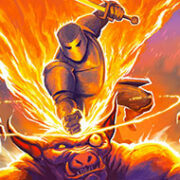


The Choicer Voicer


You grab the microphone, the on-screen prompt flashes a character you have never once practiced, and a row of cartoon judges leans forward waiting to see if you commit to the voice or chicken out halfway through. That split-second panic is the entire pitch of The Choicer Voicer, a party game built entirely around vocal impressions rather than reflexes or trivia.
| Genre | Party / vocal impression comedy |
| Platform | Windows, Linux |
| Core Loop | Perform a prompted impression, get scored by judges, unlock the replay clip |
The format traces back to a single minigame, The Choicest Voice, from a Mario Party installment where players imitated a randomly chosen character while a panel of enemies judged the attempt. The Choicer Voicer takes that five-minute idea and stretches it into a full standalone game, keeping the judging-panel structure but opening up who gets voiced, who does the judging, and how the whole thing gets dressed up.
Finding Your Voice in The Choicer Voicer
Each round hands you a prompt card built from whatever content is currently loaded, and you have to perform it in the voice attached to that prompt. There is no script memorization and no timer forcing perfect delivery; the tension comes from committing to a voice you are not confident you can pull off in front of other people. That lands hardest with groups who already do impressions for fun off-screen.
Players who treat the game as a straight competition tend to bounce off it faster than players who treat it as an excuse to be ridiculous with friends already comfortable making noise together. The scoring exists, but the actual draw is watching someone commit fully to a bad accent and getting the room laughing before the judges even weigh in.
How many players can join a session is one of the first things people ask before buying in, and the answer is up to four in the local studio format. Streaming groups get around that cap differently, since the Twitch-facing mode routes judging through chat votes instead of a fixed panel.
Judges, Studio Shows, and Twitch Rounds
The default studio game show format sits you and up to three others in front of computer-controlled judges who vote round by round on whatever impression just happened. It plays like a mock competition show, complete with a host character and a studio backdrop swappable through the customization menu. Nothing about the judging is meant to be taken seriously; the panel exists to give each round a punchline, not a rigorous scorecard.
The Twitch-oriented variant changes who holds the power. Instead of fixed AI judges, viewers vote live on the streamer’s attempt, turning the game into a broadcast tool as much as a party toy. This is the version that pulled the most attention inside the Vinesauce streaming community, adopted specifically because it gives chat a fast way to react to a streamer doing a bit.
Building Voice Packs in The Choicer Voicer
Because the base game ships with comparatively little built-in content, most of what people actually play is community-made. Voice packs are just folders of audio files, which means anyone can build one without touching code. The general process looks like this once you understand the folder structure:
- Collect or record short audio clips for the character or personality you want represented.
- Drop those files into the correct pack folder using the naming pattern the game expects.
- Load the pack from the customization menu alongside menu, judge, studio, host, and contestant packs.
- Test a round to confirm the prompts trigger the right clips before sharing the pack.
This modularity is why the community grew packs well outside the game’s Mario Party origins, including cartoon characters and inside-joke packs built around specific streamers like Vinny and Joel. None of that ships by default; two different groups can end up with completely different-feeling sessions.
Dub Mode and Reading a Scene Cold
Dub Mode swaps the judged-impression loop for straight voiceover work. Instead of being scored, you are handed a scene and asked to dub it, which suits players who enjoy performance for its own sake rather than chasing a score. It is quieter, closer to a recording booth exercise than a show, and tends to get used by groups making content afterward rather than mid-party groups chasing laughs.
Why The Choicer Voicer Still Feels Unfinished
The project is openly in early access alpha, and it plays like it. The built-in content is thin enough that skipping community packs leaves very little to do, which is a real sticking point for anyone expecting a complete party game out of the folder. Players who understand they are buying into a content platform first and a game second get much more out of it.
A more practical complaint is microphone reliability. Recording issues are common, and they get noticeably worse on setups running surround-sound audio configurations, sometimes to the point where a round fails to capture anything usable. If your microphone stops registering mid-session, checking your audio input against a standard stereo setup is usually the first fix worth trying.
None of that erases what The Choicer Voicer gets right when a group leans into it: a simple judged-performance loop, wrapped around content packs flexible enough that the game can be reshaped into wildly different in-jokes, from a Mario Party throwback bit to a full Twitch chat game. Whether it’s worth returning to still comes down to whether you or your group are willing to build the voice packs that make a given session actually funny, rather than waiting for the base install to do that work for you.