


Extreme Car Driving Simulator

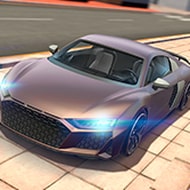
Extreme Car Driving Simulator looks like a quick stunt toy from its store screenshots, just a car, a ramp, and an open field, but it actually demands a working feel for weight transfer, throttle control, and momentum the moment a player tries anything past a straight line. What reads as a casual pick-up-and-play driving app on the surface plays much closer to a physics sandbox that punishes sloppy inputs at full speed.
| Genre | Open-world driving simulator |
| Platform | Mobile, Android and iOS |
| Core Loop | Drive, drift, jump ramps, earn currency, unlock and customize cars |
| Camera Options | Exterior, interior, hood, wheel |
An Open Map Instead of a Track in Extreme Car Driving Simulator
Most driving games funnel players down a closed circuit with checkpoints and a finish line. Extreme Car Driving Simulator drops the checkpoints entirely and hands over a full city instead, with ordinary traffic moving through the streets, an offroad zone built around rougher terrain, an airport runway long enough to reach top speed, and Extreme Island, a newer area built around beaches, a stadium, and a lighthouse.
There is no penalty for driving the wrong way, no rival car forcing a specific route, and no need to slow down for traffic since it is not scripted to chase or block anyone. That absence of structure is the entire pitch: the map exists to be explored and abused rather than completed, and a session can just as easily turn into ten minutes of drifting around one intersection as it can a full lap of the city.
The tradeoff is that a map this open has no built-in sense of progress unless a player creates one personally, picking a target like reaching the lighthouse on Extreme Island, or seeing how many buildings can be climbed before a crash ends the run.
Physics That Punish Sloppy Throttle Control
The driving model leans on weight shift, grip, and momentum rather than simple point-and-steer input, which means a hard direction change at speed genuinely unsettles the car instead of just changing its heading. Drifting works the way real weight transfer does: easing off the throttle mid-turn breaks traction, and reapplying it too early snaps the car straight instead of holding the slide.
Ramps expose this physics model more than anything else in the game. The mega ramp in particular punishes guesswork; most players who have spent real time with it report that an approach speed somewhere around 150 to 180 km/h is the sweet spot for clearing the jump cleanly, with anything slower or faster usually ending in a nose-first crash instead of a landing.
Car damage is tracked visibly, with dented panels and cracked glass building up the more a car gets thrown into walls or landed badly, though repairing that damage afterward costs nothing, which softens the consequences enough that reckless driving never actually ends a session outright.
Career Mode, Extreme Fest, and the Other Ways to Drive
Career Mode is where most of the structured content sits, split into chapters that each focus on a different driving discipline, Time Trial challenges against the clock, and straight Races against bots, with new vehicles unlocked as rewards for clearing each chapter rather than bought outright.
Extreme Fest adds races against other drivers, Stunt Races focus on trick scoring over raw speed, and Survivor mode strips away the safety net entirely, testing how long a car and driver can hold together under constant punishment. Trial and radar challenges, along with a dedicated Destruction mode built around wrecking as much as possible, round out the mode list for anyone who gets bored of roaming alone.
None of these modes replace the open map; they sit on top of it, giving structure to players who want it while leaving the core sandbox untouched for everyone else.
Building a Garage: Paint, Vinyls, and Interior Swaps
The vehicle roster spans SUVs, classic cars, sports and racing models, drift-tuned cars, and specialty vehicles like the Police Interceptor for players who want a chase-styled car rather than a straight racer. New cars typically join the garage through driving and completing chapters rather than sitting behind a single unlock method.
- Full-body paint jobs and solid color options
- Wheel and tire swaps
- More than twenty exclusive skins and vinyl designs
- Spoilers and license plates
- Custom interior colors and dashboard styles per vehicle
None of this customization changes lap times in a competitive sense, since there is no ranked ladder attached to it, but it matters for exactly the kind of player Extreme Car Driving Simulator is built for, someone who wants their car to look the part while drifting through the offroad zone, not someone chasing a leaderboard.
Cameras, Controls, and the Real Learning Curve in Extreme Car Driving Simulator
Players can switch between arrow-style, wheel, or gyroscopic tilt controls, and pick from exterior, interior, hood, or wheel camera views independently of whichever control scheme is chosen. Gyro controls in particular take real adjustment; tilting a device to steer feels natural in short bursts but gets fatiguing across a longer Career Mode chapter, which is why a lot of returning players eventually settle on the on-screen wheel instead.
New players consistently underestimate how much the interior and hood cameras change the difficulty of judging a jump or a tight drift compared to the wider exterior view, and switching camera mid-session is one of the more overlooked adjustments available.
The learning curve is not about memorizing a track, since there is not one; it is about building a feel for how a specific car handles weight transfer under the control scheme chosen, and that feel does not transfer cleanly between gyro and wheel input.
What Players Actually Argue About
The most consistent complaint across reviews is advertising: pop-ups that interrupt driving sessions and, according to several player reports, show up roughly every minute and a half of play, sometimes covering enough of the screen to interfere with the controls underneath.
There is a genuine split in how players talk about the game itself. Some reviews call it unpolished compared to dedicated racing simulators and criticize newer updates for tacking on features that feel disconnected from the core driving model. Others argue that exact lack of polish is beside the point, since the freedom to roam, crash, drift, and stunt without rigid constraints is what the game is actually selling, and no amount of missing polish undoes that.
Both camps are usually reacting to the same design decision: an open, low-consequence sandbox will always feel looser than a simulator built around lap times and penalties, and whether that reads as freeing or sloppy tends to depend entirely on what a player came in expecting.
What is the Police Interceptor for in Extreme Car Driving Simulator?
It is one of the specialty vehicles in the garage, built around a chase-styled look rather than outright top speed, aimed at players who want police-chase style role-play driving instead of straight racing or drifting.
What speed should you hit the mega ramp at?
Most experienced players approach the mega ramp around 150 to 180 km/h. Coming in under that range tends to leave the car short of the landing, while overshooting it usually ends in an uncontrolled nose-first crash instead of a clean jump.
How does Career Mode work in Extreme Car Driving Simulator?
Career Mode is broken into chapters that each test a different driving skill through Time Trial runs and Races against bots, and clearing a chapter unlocks a specific vehicle tied to it rather than requiring it to be bought separately.
Extreme Car Driving Simulator was never really trying to be a lap-time simulator, and once that is clear, the ads and the rough edges read less like flaws and more like the cost of a game that would rather hand a player an entire city, a mega ramp, and a Police Interceptor than lock all of it behind a track and a finish line.